Hot Wax - M. L. Rio
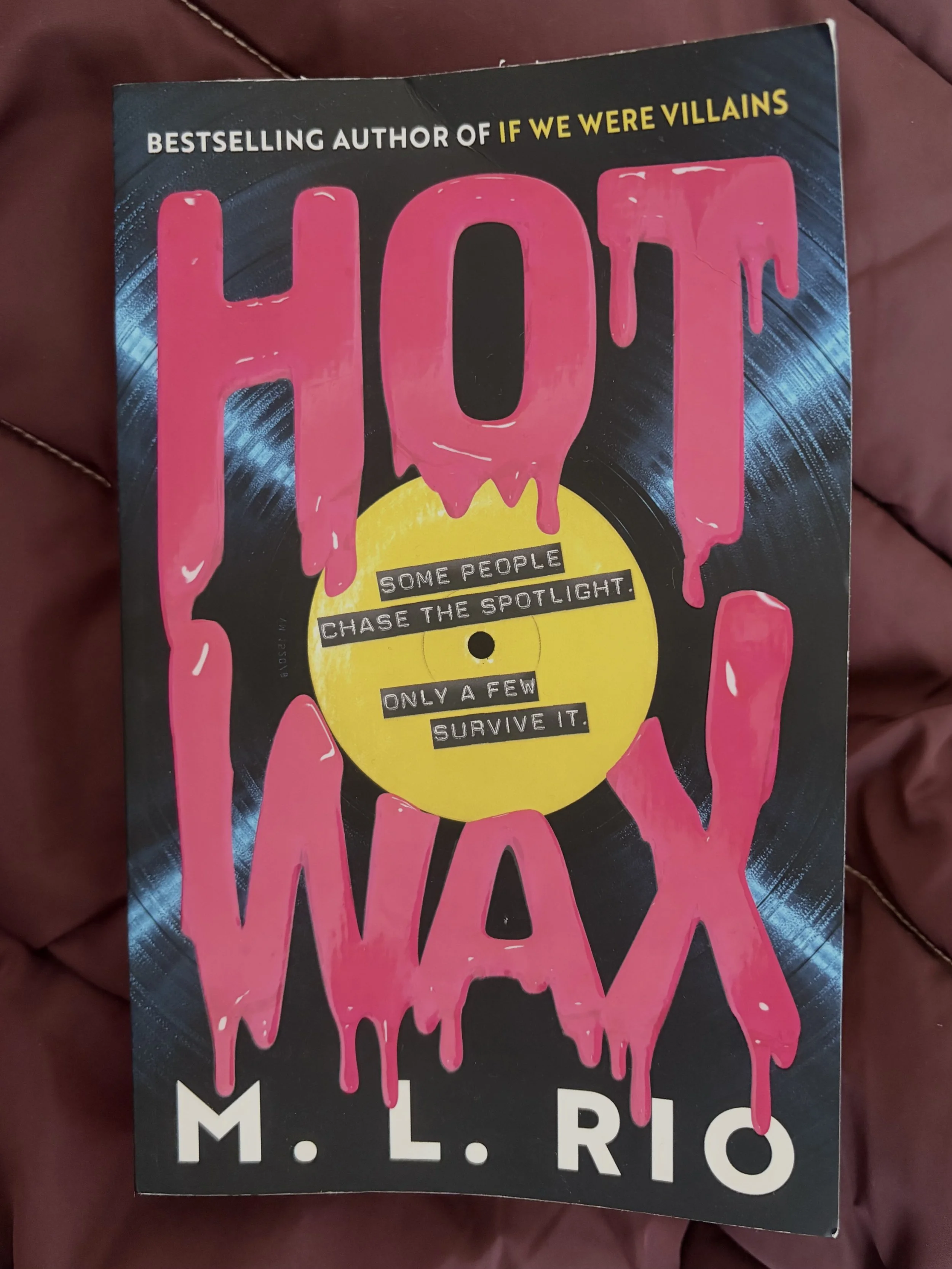
Suzanne spends one brutal summer on tour with her father’s rising rock band, then spends the next three decades trying to outrun its fallout. When Gil dies, she flees her suburban life and goes searching for the truth she buried—only to find freedom, danger, and the version of herself she thought was gone, while her husband hunts her across the country.
Yet despite all that narrative momentum, my reaction to the book itself was… disappointing. All of that left me with one unavoidable conclusion: it’s going straight to my Goodreads DNF shelf — two measly stars, and not a shred of heart left to go back. And it’s made me really quite sad, because M. L. Rio is the writer of one of my favourite books of all time: If We Were Villains, and that book left me on some kind of reader’s high. Which gave me the impression that whatever else she might write was going to be just as gobsmackingly good as that one. Alas, I was very wrong, and it baffles me. How can an author write one stunningly beautiful novel, followed by another one that hits different — and not in a good way.
Now before you mention it, I do own M. L. Rio’s Graveyard Shift. I haven’t read it yet, but the genre and themes are very similar to If We Were Villains, so I have high hopes for it. But as of right now, I cannot speak for it — so all my thoughts on M. L. Rio and her books are solely based on the two I have read.
I feel M. L. Rio overwrote every aspect of this book. To put it bluntly, the plot was very much lost in all the description. As a reader, I can imagine things as I go; I do not need every placement of every object in a living room that Suzanne walks into. I do not need to know every minuscule facet of her life — I should be able to piece together relationships and their type of connection through minimal explanation. A little detail here and a little detail there is fine, but when Rio writes on page 130:
“He looked about nineteen, grinning like the devil he would evidently grow up to be. More disturbing was the family resemblance. He looked just like Suzanne, or she like him. The same deep eyes, the same long lashes. Same ears…”
Yep, I think we get it. This much description wasn’t needed. The man she talks about is Rob — he’s been mentioned before, I already have an image of him in my head and it fits fine with everything else. Why am I rereading stuff that I’ve already depicted? It’s boring.
Not to mention the other quote I tabbed on page 114:
“Suzanne caught flashes of metal, patches of rust, the spokes of an enormous wheel casting shadows on the ground like a sundial turned sideways. What she had mistaken for mounds of earth were the oxidizing skeletons of a dozen broken-down tractors, sinking into the landscape…”
To me, that’s a load of waffle.
The whole book feels like waffle. Almost as though she had to over-describe the narrative scenes because her plot wasn’t strong enough to hold all the weight.
Her characters were fine, but there were too many of them and a little bit cliché. Some of Rio’s character archetypes feel overly familiar, leaning on well‑worn tropes rather than fully surprising or subverting them. In a story that’s begging for messy, unpredictable people, too many of the cast slip into pre‑packaged roles — the tortured genius, the loyal sidekick, the brooding love interest — without ever pushing past their template. It leaves the emotional beats feeling a bit rehearsed, as if the characters are performing the idea of depth rather than embodying it.
Despite those major disappointments, some of her similes, metaphors, personification, and hyperboles were really good and original — poetic and imagery‑building — but there was too much of it. By about page 70, I could only read ten pages at a time without stopping for a break. Reading such tedious, flat writing is hard work. I can’t carry on; I need something that’s going to give me a thrill, maybe something that’s a bit different too. So for my next read, I’m going to be diving into the fantasy genre with the very popular duology Six of Crows. So if you’re interested in that, stay tuned to see whether it’s worth the read or not.
For now, I can’t recommend Hot Wax. It’s like walking through quicksand — the deeper you sink, the harder it is to get through it.
However, I’m not against anyone who might enjoy it if they decide to give it a go. Plenty of people did like it, there’s proof everywhere. It just wasn’t for me, and like my friend Freya Mathieson says “if it’s not serving you, get it out of your life (applies for people as well)”.
Buy your copy of the book here: https://amzn.eu/d/0dLzVPLF