
Book Reviews
Carmilla - Joseph Sheridan Le Fanu
A sudden carriage crash brings the entrancing Carmilla into Laura’s secluded world, igniting a strange, seductive friendship that quickly turns vampiric.
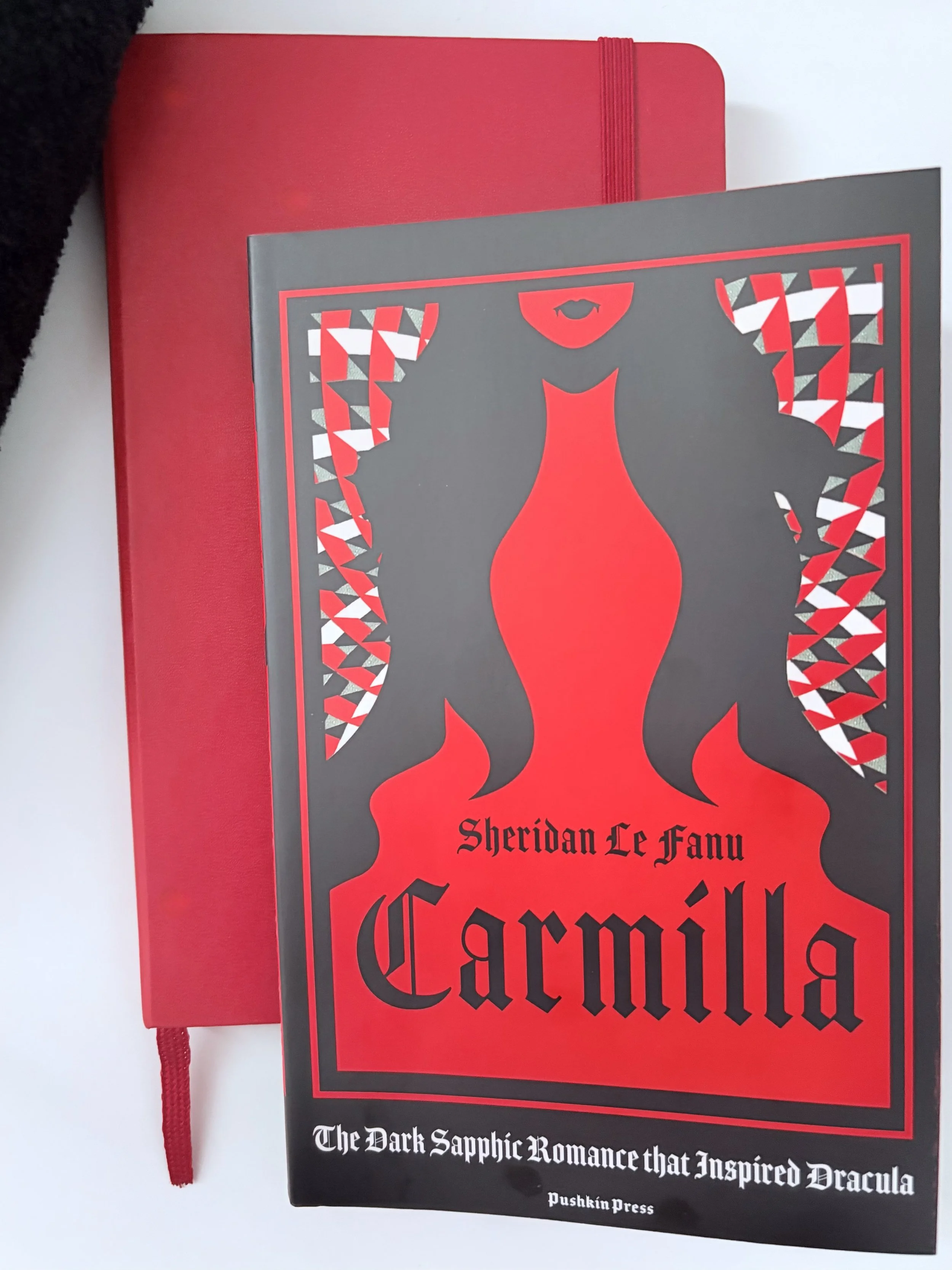
Laura’s isolated life in a remote Austrian castle takes a wild turn when a carriage accident drops the enchanting Carmilla on her doorstep, sparking an intense and eerie friendship. As Laura grows weaker and Carmilla grows stranger, the story unfolds into a seductive, gothic vampire tale that won’t let you down.
Now, I’m taking a different approach with this review, as the book stands apart from anything I’ve read before. I want to unpack this as best I can because boy does it deserve the attention. Apologies if it’s essay-like, my tiny mind has a lot to say.
I don’t usually read horror classics, and I rarely enjoy traditional classics in general, but Sheridan Le Fanu’s Carmilla completely surprised me. It’s extraordinary and captivating from the moment I sat down with it. Unlike many other older novels such as Frankenstein or The Great Gatsby, Carmilla is genuinely easy to read despite its dated phrasing, both in description and dialogue. I was thrilled by this, because I cannot stand when a book forces me to stop and decode every single sentence. I simply don’t have the energy for that, and the story ends up slipping away from me, which feels like such a loss.
I love stories. I want to understand them, to be immersed in the worlds authors work so hard to create. But that becomes impossible when I’m faced with lines like this from Mary Shelley’s Frankenstein: “It was the secrets of heaven and earth that I desired to learn; and whether it was the outward substance of things, or the inner spirit of nature and the mysterious soul of man that occupied me, still my enquiries were directed to the metaphysical, or in its highest sense, the physical secrets of the world.” (p. 39). It’s beautiful, I can’t deny the power of the language, but I still find myself pausing, trying to fully grasp what Shelley means before I can move on. The flow breaks. The experience becomes stop‑and‑start, and eventually frustrating.
That leaves me with two choices: either I give up because I’m tired of not understanding, or I push through and finish a story that ends up meaning nothing to me because the language kept me at arm’s length. That’s not to say I don’t appreciate classics though—they’re the original foundations of so much modern storytelling, and I truly believe the world needs them. Their themes and messages are powerful in ways few contemporary works can match. But Carmilla stands out because it lets me enjoy those timeless qualities without making me fight the prose to get there.
So, without a doubt, Carmilla is one of the prettiest novels I’ve read - if you can call a book pretty? I think you certainly can, and if you give this one a whirl you’ll understand the vibe.
Carmilla is basically the queen of the Female Gothic, and honestly, she knows it. The whole story takes place in super domestic, feminine spaces—castles, sickrooms, cosy little drawing rooms—and somehow Le Fanu has made it all absolutely terrifying. I had chills. It was strange. I was horrified. Carmilla and Laura’s relationship is the perfect mix of “aww that’s sweet” and “oh god she might kill you,” which is exactly the kind of emotional whiplash I think a Female Gothic thrives on. And underneath all that lace and candlelight is a very real critique of how vulnerable women were in a patriarchal society. Basically: men are useless, women are in danger, and the vampire is the only one getting things done.
Then, obviously, my favourtie feature - in honour of Pride month, again: Le Fanu kindly provided us with queer subtext, which - if i’m being honest - isn’t even subtext half the time. Carmilla is out there making heart eyes at Laura, and Laura is quite understandably, confused, flattered, and mildly dying. It’s one of the earliest vampire stories (origninally published in 1872) to openly explore same‑sex desire, and it does it in that classic Victorian way where everything is both deeply romantic and deeply repressed. It was a beautiful experience reading it. Carmilla’s affection is tender one moment and predatory the next, which creates this delicious tension between lust and danger. It’s like the book is whispering, “Being gay is beautiful… but also maybe deadly… but also beautiful again.” And because of this captivating back‑and‑forth, I ended up getting this weird ASMR effect from the writing during the more intimate scenes. Books rarely give me physical sensations, but this one? It was like the words were literally whispering to me. I swear I could feel Carmilla’s eerie yet lascivious presence in my own bedroom, which is not something I was emotionally prepared for on a Saturday night.
It’s safe to say I was freaked out by Le Fanu’s protagonist, but at the same time I was completely absorbed by her beauty and that unnerving sense of calm she carries around like a perfume. She terrified me, enchanted me, and honestly? I didn’t know whether to run or offer her a cup of tea.
And as if all that wasn’t enough to get me excited about a classic novel that I did in fact doubt I’d enjoy before I bought it; there’s the whole vampirism side to it and it’s brilliant hidden metaphor, which is basically a buffet of symbolism. You want repressed sexuality? It’s there. Illness? Absolutely—Victorians loved a good tragic cough. Fear of the foreign “other”? Yep, Carmilla literally strolls in from nowhere and everyone panics. Carmilla isn’t just a vampire; she’s the embodiment of every Victorian anxiety rolled into one very pretty, very chaotic woman. And honestly? She slays. Literally and poetically. I honestly couldn’t be more into this life than I already am.
Finally, with all that said, I definitely think you need to read this. It’s not a long novel — just 156 pages — but it’s jam‑packed with greatness.
Buy your copy of the book here: https://amzn.eu/d/0beXiP2n
The Last Murder at the End of the World - Stuart Turton
Stuart Turton’s latest novel is about a murder that has quite literally happened at the end of the world. It hasn’t been told how one might expect it to be told, but it’s a story that entices the reader with its strange thoughts on what the world might look like in hundreds of years time, as well as its unique storyline and characters.

Stuart Turton’s latest novel is about a murder that has quite literally happened at the end of the world. It hasn’t been told how one might expect it to be told, but it’s a story that entices the reader with its strange thoughts on what the world might look like in hundreds of years time, as well as its unique storyline and characters. It takes a very curious and courageous mother through the journey of investigating the murder of a scientist named Niema, but not everything is at it seems. Nobody knows why or how Niema has died, and with her death being a death trap for the villagers living on the island, the fog is closing in faster than people can keep up with; and the only way to stop the fog is to find out who Niema’s killer was. But do they ever find them at all? That’s something you’ll have to find out. The clock is ticking, there’s secrets to unveil, and villagers to reassure; it’s intense, extremely detailed, and like nothing you’ve ever read before. I think it’s like Marmite, you’ll either love it, or you’ll hate it.
Let’s just say, I’m not a fan.
33 days later and I can say that I’ve read it all, front to back, without a single doubt in my mind about how I feel about Turton’s Dystopian, Sci-Fi, crime, and mystery novel.
So with that said, I think it’s finally safe to say that (if it wasn’t already clear) I didn’t enjoy this book at all. The concept is pretty cool, but if we’re considering the fact that the story is about someone’s murder, it doesn’t introduce it until one hundred pages in which made the first third of this book quite difficult to get through. It was information heavy and much of it wasn’t necessary in my opinion, and not a lot happened. Nothing exciting, anyway. Nothing that raised my hairs and quickened my heartbeat. Turton’s plot was too slow paced for me. Niema’s death was a surprise but only because I wasn’t expecting it to happen so late in the story. The story would have been interesting if she’d died right off the bat, but instead I had to get through an information overload that had me zoning out every five pages. And how it happened wasn’t anything that stirred my emotions either. It felt quite bland, and because of that it was a tedious read.
On top of its plot, almost every single character in this story annoyed me. I never warmed to any of them, and I never wanted anyone to leave the book with a positive outcome. I simply wasn’t bothered about their storylines. They annoyed me too much, but then again, I guess that means they were pretty realistic and well thought out. However, I can’t say that Turton did this to his characters on purpose, he might have actually wanted them to be loveable and to have his readers rooting for them. I never saw them in that light, and I still don’t even after I sat back to think about how and why I’m approaching this review the way I am. Instead, I found myself wanting to shout at them, begging them to do exactly the opposite of what Turton had them doing. Plus, there were character’s mentioned in this book that were never explained, or introduced properly, they were just referred to every once in a while, which left me assuming that they weren’t important and that they were simply villagers left in his story to help show what life is like in the world they live in.
It saddens me to say, though, that I’ve never experienced such negative emotions whilst reading a book before and that in itself took me by surprise.
The Last Murder at the End of the World wasn’t at all what I was expecting. I kept thinking about how I could write it, removing all factors that make it Sci-Fi and Dystopian because I’m not sure that helped his idea. It made it confusing, and some of it I felt didn’t make much sense. Though I do blame that opinion on the fact that I zoned out a lot while reading this book, and therefore missed some key parts in Turton’s story. However, a good book holds onto the readers’ attention throughout his or her story, and because Turton’s didn’t do that for me, it wasn’t a good book. I didn’t care enough to stay in his world for more than five or ten minutes at a time.
Admittedly, I’m only one person out of the hundreds who have read this, and everybody is different. There’s people out there who’d rave about this novel all day and all night, and I’m unfortunately not one of them. So, if you’re like me, and aren’t a fan of science fiction, complicated murder mysteries that haven’t been executed in a way that’s easy to follow, or simply dislike books that have a wishy-washy beginning, middle, and end, then I don’t recommend Turton’s latest novel. It sort of put me off his other books, but I shan’t judge them based on this book solely. He writes in different genres every time, perhaps this genre isn’t his forte? I know it’s not mine.
By your copy via the link below: