
Book Reviews
Bad Queer - Gayathiri Kamalakanthan
Surya enters their final school year unsure whether Blessing sees who they truly are.
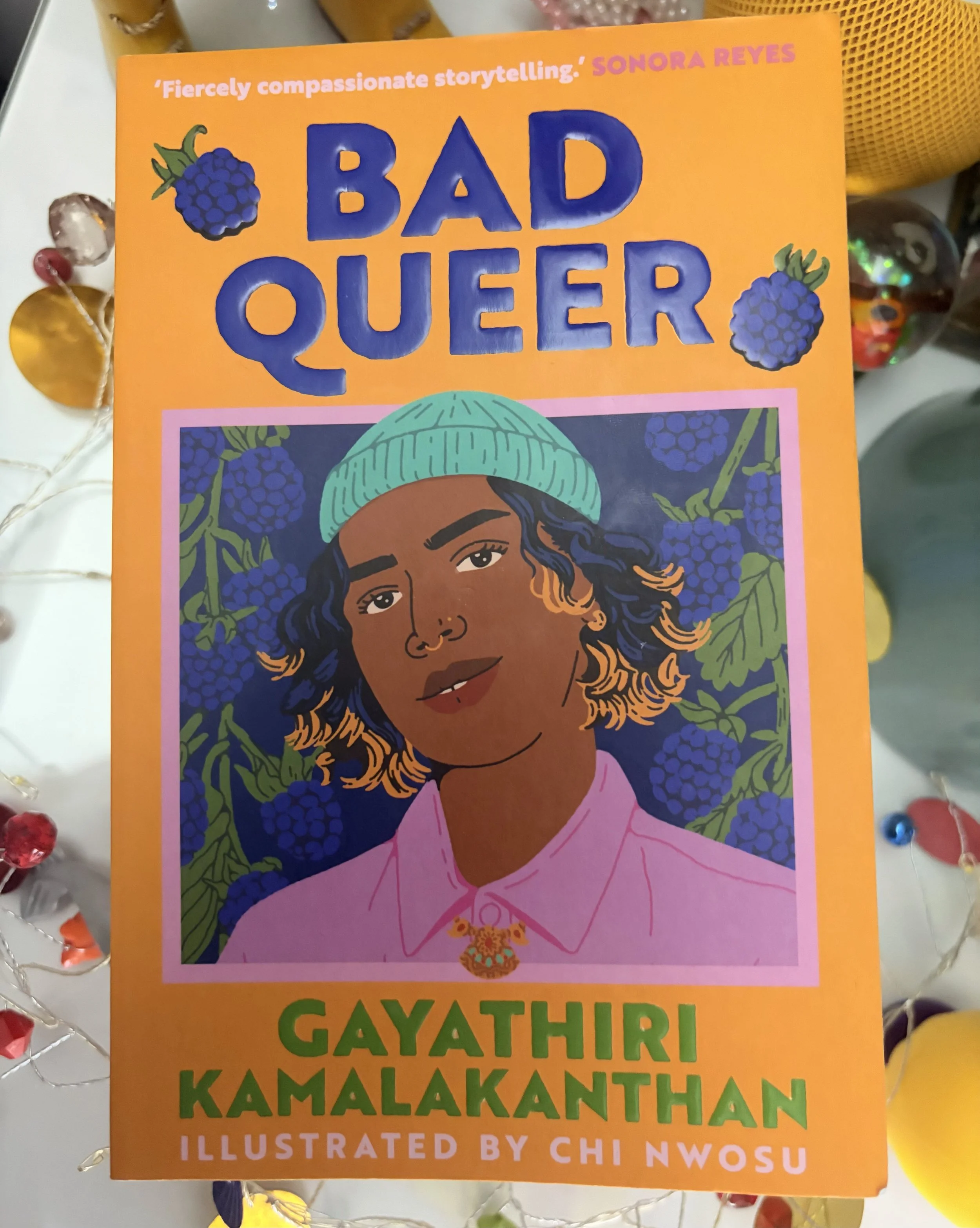
Surya is non‑binary, but falling for Blessing complicates everything as they begin to wonder whether he truly sees them, or just an imagined version. As their final school year unfolds and friendships shift, Surya must navigate first love, identity, and the desire to be understood.
Gayathiri Kamalakanthan has written a deeply moving story through poetry. The short stanzas make for a quick read, but never at the expense of emotion. Kamalakanthan can make three words feel as powerful as a full sentence in a prose novel, and because of that, I’m sure this queer story will resonate with every reader who picks it up — or is about to.
Now, I finished this in about a day and a half, though I technically started it a month ago. The silly little break I took was because I’m a hardworking student at university writing my own stories for very serious deadlines… so I apologise for the delay in my reading. But when I picked it back up, I thought: what better way to start my 2026 summer reading journey than with a queer book that aligns with June’s purpose — to shed light on queer communities across the world, better known as Pride Month. So, happy Pride to all, and I hope this review is useful.
First things first: this is a good book, no doubt about it. However, I’m only giving it three stars. For many reasons — the first being that I did not like the protagonist, Surya. They made a lot of good points that I’ll stand by forever, but they also got on my nerves quite a bit. They often came across as selfish, and at times — particularly in their relationship with Blessing — a little forceful. Not aggressively so, but in a way that someone might not even realise they’re being.
This book is about identity, navigating love, and being free and curious about it all. But I felt that message was contradicted when Surya confessed their feelings for Blessing and put him in a pressured position where he had to reconsider his own identity to accommodate theirs. Not that Surya wasn’t understanding, but I don’t think they gave Blessing much space to truly consider the situation. Especially since Blessing knows he’s a straight cis man; and having Surya remind him that they’re not a girl, so this wouldn’t be a straight relationship, felt a bit forceful and unfair — particularly when he clearly showed hesitation. And unfortunately, from experience, I don’t think telling someone they could be something else when they’re sure they aren’t is ever a good idea. So yes, that annoyed me and gave me a negative outlook on the protagonist — and the protagonist is supposed to carry the story. When you don’t like them at all, it becomes harder to enjoy the book as much as you might have if they were a little more likeable.
That isn’t to say it’s entirely a bad thing, though. Flaws are desperately needed in characters; without them, a story becomes less believable and lacks depth. Kamalakanthan did a good job creating a character who feels very true to certain people today, both in their queerness and in their very human actions and motives.
The second reason for this three‑star rating is the dialogue. At times, it felt like full, well‑crafted speeches rather than natural conversation, which gave it an unnatural and emotionally distant tone. Perhaps this is due to the poetic structure — and if so, it makes sense stylistically — but it doesn’t change how that style affected my reading experience. It made the characters feel a little robotic.
And finally, the thing that bothered me most was the ending. Personally, it didn’t feel like an ending at all. It cuts off mid‑dialogue and leaves you on a cliffhanger you desperately want resolved but are forced to imagine it instead. It simply stops, and the result feels incomplete which is disappointing, considering how strong the overarching storyline was. The final page certainly didn’t do it justice. And I know that alone might be a make‑or‑break point for you. Honestly, if I’d known the ending was going to be below par, I probably would’ve skipped the whole thing myself. So there’s no judgment from me if you no longer have any intention of reading this now, though, like a lot of things in life, you don’t know until you try…
Overall, the story feels emotionally heavy while you’re in it, but once it ends and you reflect on its themes and scenarios, it’s actually quite a light book to hold — not a lot truly happens. It’s definitely a character‑driven story, fuelled by feelings and personal choices rather than major, action‑packed plot twists. So if you like easy‑paced, relatable, heartfelt stories, Bad Queer might be for you. It’s different, and it sheds light on a topic that doesn’t get spoken about often, yet it’s beautifully presented through poetry that flows — sometimes in concrete form too — so you’re taken on a journey through exactly how Surya is feeling in every moment of each scene. It’s illustrated as well, which helps bring the story together visually, and that I really enjoyed. It’s colourful, full of life and culture, and because we’re celebrating a very important time of year, please do my little writer heart a favour: buy it, read it. You’re not only educating yourself on a complex queer experience, but you’re also supporting a queer writer (Gayathiri Kamalakanthan), and creating something this honest is both brave and deeply touching.
Buy your copy of the book here: https://amzn.eu/d/07FQBq2V